
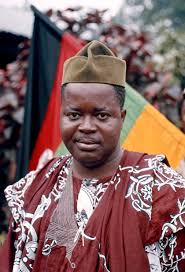
Dr. Michael Iheonukara Okpara
GCON,LMS (NIG), LAH (IRELAND), MRCP (UK), HON. LL.D (UNN), HON. D.SC (UNIBEN).
Michael Iheonukara Okpara (25 December 1920 17 December 1984) was a Nigerian politician and Premier of Eastern Nigeria during the First Republic, from 1959 to 1966. At 39, he was the nation’s youngest Premier. He was a strong advocate of what he called “pragmatic socialism” and believed that agricultural reform was crucial to the ultimate success of Nigeria.
Late Dr. Michael Iheonukara Okpara, was born in December 25, 1920 at Umuegwu Okpuala, Afugiri, Ohuhu, in Umuahia Local Government Area, in the present day Abia State of Nigeria. Although he was the son of a labourer, he was able to attend mission schools and later went to Uzuakoli Methodist College, where he won a scholarship to study medicine at Yaba Higher College, Lagos. After completing his medical studies at the Nigerian School of Medicine, he worked briefly as a government medical officer before returning to Umuahia to set up a private practice.
A strong advocate of what he termed “pragmatic socialism”, Okpara believed that Nigeria’s salvation depended on agricultural revolution. To this end, he acquired and managed a large farm in his hometown, called Umuegwu Okpuala Mixed Farms, which inspired many Eastern Nigerian leaders to follow suit. Under his reign as premier, Eastern Nigeria thrived basically on agriculture which was his fulcrum for socio economic empowerment. He is fondly and nostalgically remembered until today for his unrepresented record of achievement in the area of agricultural, housing and industrial development in the then Eastern region, including the present day Niger Delta, a record no other leader of the Eastern region or later States came near to until today.
It was at this time that the young Okpara developed an interest in the Zikist Movement (named after Nnamdi Azikiwe), a militant wing of the National Council of Nigeria and the Cameroons (NCNC). After rioting workers were shot by police at the Enugu coal mines in 1949, After the shooting of rioting workers at the Enugu coal mines (1949), Dr. Okpara was one the Zikists arrested by the government for allegedly organizing the workers for political ends. He was later released.
Following the introduction of internal self-rule in Nigeria by the British in 1952, Okpara, then popularly called M. I. Power, was elected into the Eastern Nigerian House of Assembly on the platform of the NCNC. Between 1952 and 1959 he held various Cabinet positions in Eastern Nigeria, ranging from Minister of Health to Minister of Agriculture and Production.
In 1953, when NCNC legislators revolted against the party leadership, he remained loyal and joined forces with Azikiwe. From 1959 to 1966. Okpara was the leader of the NCNC and Premier of Eastern Nigeria during the First Republic. In November 1960, when Azikiwe left active politics to become Nigeria’s first African Governor-General, Okpara was elected leader of the NCNC. Very forceful, outspoken and fearless, Dr. Okpara is uncompromising on vital national issues which led in 1963 led to severe strain in relations with the ruling Northern Peoples’ Congress of the late Prime Minister Abubakar Tafawa Balewa, with which the NCNC formed the country’s first post-independence Government.
After the military coup of January, 1966, Okpara was one of the politicians detained by the Ironsi regime but he was released in July after a second coup swept General Ironsi out of power. He and late Chief Dennis Osadebay of the Mid-West were the only Regional Premiers who survived the army revolt of January, 1966, in which two other premiers were killed.
A strong advocate of what he termed “pragmatic socialism”, Okpara believed that Nigeria’s salvation depended on agricultural revolution. To this end, he acquired and managed a large farm in his hometown, called Umuegwu Okpuala Mixed Farms, which inspired many Eastern Nigerian leaders to follow suit. Under his reign as premier, Eastern Nigeria thrived basically on agriculture which was his fulcrum for socioeconomic empowerment. He is fondly and nostalgically remembered until today for his unprecedented record of achievement in the area of agricultural, housing and industrial development in the then Eastern region, , including the present day Niger Delta, a record no other leader of the Eastern region or later States came near to until today. It is of note that Michael Okpara ended up building the fastest growing economy in the world as a Premier of Eastern Region.
One of Dr. Okpara’s most famous quotes that underscored his economic wizardry was at the Convocation ceremony of the University of Nigeria, Nsukka on17th December 1962, titled, Progress Without Tears:
“I have never understood why Nigeria should export 41y ,947 tons of raw cotton in 1961 valued at £9.5 million while importing 177, 684, 000 square yards of textiles valued at £19 million. Why should we continue to import such heavy commodities as cement when limestone abounds in this country? The only adequate answer to the European common Market with the obnoxious tariff walls is our manufacturing most of what we import from them. With the best will in the world, this will take time .But a start must be made now by deliberately concentrating on those goods which can be easily manufactured here thereby saving foreign exchange. I have already mentioned two, but I believe that it is possible to concentrate during this period of the plan on three specific fields covering food, clothing, and shelter.”
In the last days of the defunct Republic of Biafra, Okpara fled Biafra with Ojukwu and to Ireland. He was later granted amnesty by the Federal Government in 1979 along with the late Biafran leader, Emeka Ojukwu after nearly 10 years in exile. Before his return, some of his close associates contributed money to build a house for him in his Umuegwu village. Remembered today as the most honest and transparent leader east of the Niger to date, it is remarkable that while he was in government, Okpara never owned a house of his own.
Dr. M. I. Okpara was a member of the Royal Academy of Physicians of Great Britain. In recognition of his contribution to populist and transparent political leadership, Okpara received Nigeria’s highest National honour of GCON (Grand Commander of the Order of the Niger), in 1964. Also, several monuments have been erected in his honour in the South East while popular Federal and State roads and insitutions have been named after him, including Okpara Way in Abuja, Okpara Avenue and Okpara Square in Enugu capital, Michael Okpara University of Agriculture, Umudike, Abia State and Michael Okpara College of Agriculture in Imo State (now renamed Imo State Polytechnic) among several others.
He died on 17th December 1984.
 THE ECHO